Biochemistry, and closely related biosciences, refer to fields studying especially humans and other organisms with the help of laboratory sciences. Such fields include biophysics, biotechnology, genetics, immunology, microbiology, molecular biology, neurobiology and cell biology. Some of these sciences are compiled under biology in statistics, which shows that the line between the sciences is not clear. Biochemists and laboratory bioscientists find employment particularly in the pharmaceutical and bioindustries, research and health care as well as in commercial tasks.
Biochemistry and closely related laboratory sciences are studied in Aalto University, the University of Helsinki, the University of Eastern Finland, the University of Jyväskylä, the University of Tampere, the University of Oulu, the University of Turku and Åbo Akademi University. Approximately 160 biochemists graduate annually (other closely related fields are found under biology in statistics). Approximately 200 biologists graduate annually.
Sources of employment and examples of employers
-
- Bayer
- Orion
- Janssen
- Pfizer
- MedEngine
- Medfiles
- Medaffcon
-
- Agilent Technologies
- Roche
- PerkinElmer
- Thermo Fisher Scientific
- Bio-Rad Laboratories
- Biogen
- Qiagen
- AB Enzymes Oy
- Hytest
- Reagena
- Roal
-
- Altia
- Fazer
- Valio
-
- GlaxoSmithKline Customer Healthcare
- Berner
- Roche
-
- THL
- VTT
- Evira
- Fimea
- Institute for Molecular Medicine FIMM
- Valvira
- Ilmatieteenlaitos
- Kemikaalivirasto
-
- erikoissairaanhoidon palvelut: HUSLAB, TYKSLAB, ISLAB…
- Fimlab Laboratoriot
- Blueprint Genetics
- Biopankit
-
- Aalto yliopisto
- Helsingin yliopisto
- Itä-Suomen yliopisto
- Jyväskylän yliopisto
- Oulun yliopisto
- Tampereen yliopisto
- Turun yliopisto
- Åbo Akademi
Phenomena in the field
- doctoral degrees
- reduction in domestic research activities
- commercial skills need in the pharmaceutical and bio fields
- growth of operations serving the pharmaceutical industry
- medicinal product development in start-ups
- biostatistics and data competence
- need of fluent Finnish language skills in most of the industry and public sector jobs
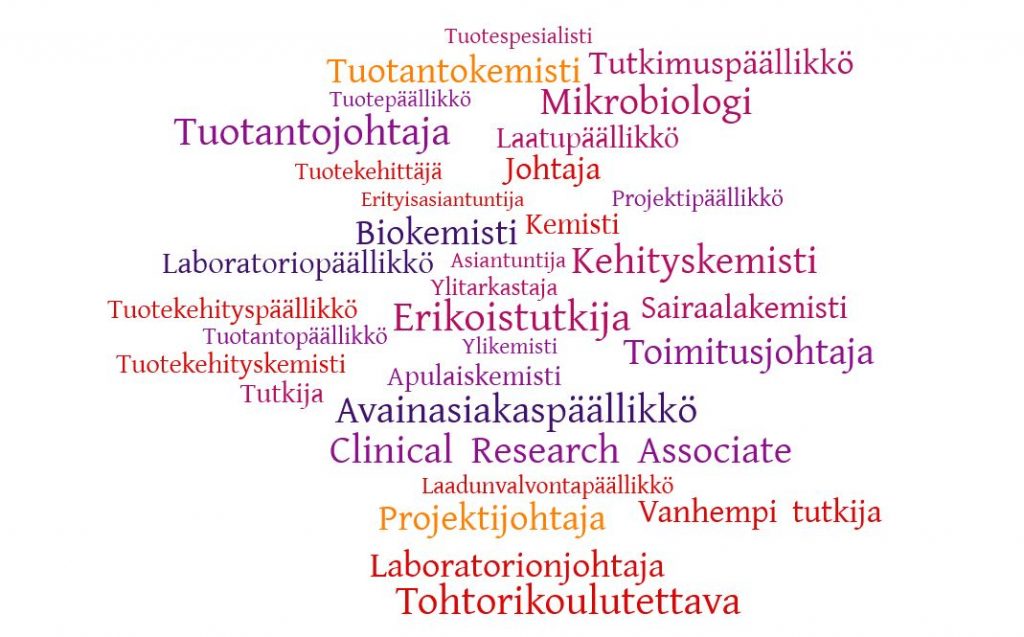
Bioscientists’ titles in Finnish job market
Employment and career opportunities
- There are 2,300 biochemists and approximately 4,300 biologists currently in the labour market.
- There are about 150 unemployed jobseekers, so the unemployment rate is just above 6 %.
- The number of doctoral graduates in the labour market is over 700, of which approximately 70 are unemployed. The unemployment rate of doctors has increased during the last year, being approximately 10 %. The employment rate of PhD’s exceeds the rate of MSc.
Biochemist's career story
The path of Eloise Mikkonen, originally from Australia, to becoming a researcher has been complicated by funding problems and an ADHD diagnosis that she only received as an adult. Her positive attitude, ability to laugh at herself and extensive support network have helped her overcome difficult times.
Skills requested in job advertisements
Vacancies for biochemists and lab-related bioscientists are often related to research and analytics. Although a degree allows you to work in a wide variety of roles throughout your career, job advertisements for early-career positions typically look for skills such as:
- Practical laboratory skills: cell culture (2D/3D, primary cells), microbiological methods (culturing, identification, aseptic technique), protein and biomolecule analyses, DNA techniques, spectrophotometry, chromatography and flow cytometry
- Data analysis and reporting: analysis and quality assessment of experimental data, statistical understanding, software (Excel, statistical software, R/Python)
- Quality management and regulated operating environment: GLP/GxP/GMP, standard operating procedures (SOPs) and documentation, compliance with quality systems and sample traceability
- Research-oriented thinking and problem-solving: experimental design and hypothesis testing, utilisation of scientific literature, ability to interpret ambiguous or contradictory results
- Communication and collaboration skills: written and spoken Finnish and English, teamwork in a multidisciplinary environment, collaboration with production, quality management, clinical teams or IT
Looking for a job?
We have listed the job adds in English in the field of biosciences – check it out!