

Competition Divides – Cooperation Repairs
Mutual competition weakens relationships, eats up self-esteem and undermines confidence in the future. It creates envy and suspicion.
We envy things that are achievable and possible for us. No one envies the privileges of the President of the Republic. Envy is directed at peers.
Occupational psychologist and organisational consultant Anna Tienhaara says that envy is strongly linked to the experience of justice and fairness. For example, if someone jumps the queue at a cashier, it may cause a strong internal reaction in us, even though it is a small matter.
“A colleague’s trip to a seminar or a grant can arouse envy and increase competition if it is perceived as unfair.”
Competition weakens confidence in the future
Researchers often have to find funding for their work themselves. Consequently, universities and research institutions are constantly competing for money.
Adjunct Professor of Religious Philosophy Aku Visala has studied the evolution of morality and consciousness and the impact of phenomena in the academic world, such as competition, on the human mind and mental health. Competition penetrates the university world at all levels, from students to administrative employees. Visala believes that this may be one of the reasons why there are many mental health problems at universities.
“Competition can break relationships, distort the relationship with oneself and weaken hope for the future.”
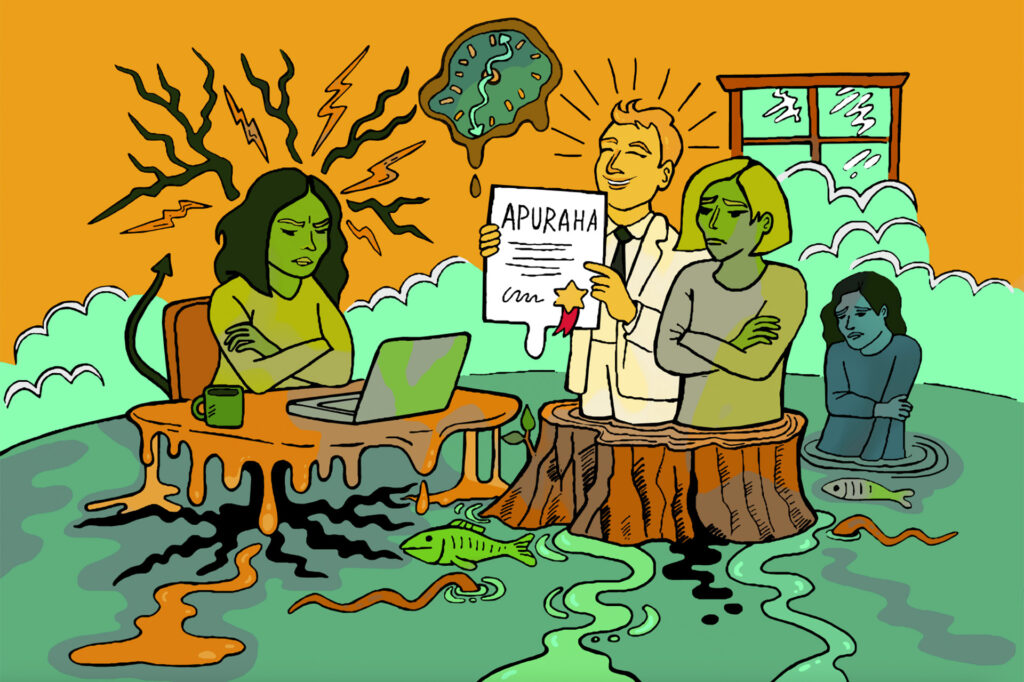
Many people’s careers and livelihoods depend on grants. More than one person competes for the same money.
Competition for funding undermines mutual solidarity and collegial relations. It drives people apart and sows suspicion between them.
“Competing for workplaces and grants makes people assess themselves unrealistically. The demands rise to a high level. The way you assess your own work and yourself may become distorted. It’s easy to make the wrong conclusion: ‘I didn’t get money or work, so I’m not good enough.’”
Person’s relationship to the future and hope weakens. In the research world, success in funding or with other applications is reflected in the entire career. No matter how well the work done is and even if you have done everything right, taught and done research, you can miss out on a reward.
“People are kept in uncertainty and they cannot plan life in the long term.”
Living with constant uncertainty is challenging. According to Aku Visala, it is easier to tolerate uncertainty if you can see your own work as meaningful, regardless of whether it is rewarded or not. The understanding of one’s own work and its value should be attached to matters that do not depend on funding, rewards or other external factors. That is not easy.
“Living in a competitive community can be made easier by building joint solidarity through horizontal cooperation, for example. Thesis students, master’s students and postdoctoral students should keep together and cultivate mutual solidarity. Sharing the experience of uncertainty with others makes it easier to tolerate it.”
Success is based on cooperation
Aku Visala reminds us that competition is not a bad thing in itself. It is not bad that a good runner wins a running competition. However, competition can become harmful, for example, when a person’s appreciation depends on winning the competition.
Anna Tienhaara says that competition can lead to good results in the short term. There are workplaces with a culture where employees exceed themselves when they compete each other. They give their all and work efficiently. In the long run, this will turn back on itself. The atmosphere becomes divided, employees do not trust each other, and cooperation does not work when everyone works for their own pocket.
Teams can also be given the opportunity to compete with each other in a positive manner. Even healthy competition can result in people turning towards their own teams and building protective walls between the other teams.
“True success is based on cooperation. True success requires sharing ideas and helping each other.
Turn envy into a resource
According to Aku Visala, envy is a sign of caring for oneself. It is a beneficial feeling that helps you see what is important.
A feeling is different from the actions and thoughts that follow it. An envious person may build up an image of the subject of their envy as a bad person who has acquired something unfairly, and they may denigrate them.
“This is a moral problem,” says Aku Visala.
Tienhaara has similar thoughts. In the worst case, strong envy can lead to sabotaging someone’s work. The envious person tries to make the other person fail.
“Envy can be turned into a positive resource. For example, envy of a colleague being able to lead an interesting project makes one’s own goals clearer.”
In academia, doing everything right is no guarantee of being rewarded.
If envy takes over your mind in a negative way, it is worth to stop. It is good to think about why this takes so much energy and what you could do to achieve the same as the envied colleague. First, it is a good idea to give room for your own emotions, such as disappointment.
Envy fades when it is spoken out loud and it will not create a spiral. Envy does not take up too much energy when you process it.
A colleague’s unpleasant behaviour may be caused by envy. Being aware of this will help you understand them. However, poor behaviour is never acceptable at a workplace.
If you suspect that someone else is envious of you, speak up. However, you do not have to take responsibility for your colleague’s feelings.
Justifying things and making them transparent slow down envy and mutual competition. For example, if one member of the group is allowed to participate in training or is raised in the hierarchy, the supervisor may say out loud that this is likely to arouse emotions and may feel unfair.
“When the facts are said out loud and explained why only one person can get this benefit at the moment, the situation is neutralised and will not escalate,” says Anna Tienhaara.
She reminds that each member of the work community has an influence on how matters are discussed and how openly unclear matters and questions are resolved.
When competition intensifies
1. Build cooperation instead of competition
- Share knowledge, ideas, and perspectives. Genuine success is rarely achieved alone-working together reduces opposition and strengthens trust.
2. Foster mutual solidarity
- Stand by your peers, especially in times of uncertainty. Sharing experiences lightens the load and helps sustain resilience.
3. Put feelings into words early
- Envy, disappointment, and feelings of inadequacy are human. When acknowledged openly, they are less likely to shape behavior or strain relationships.
4. Make decisions and their rationale visible
- Openness and transparency reduce suspicion. When choices and the reasons behind them are communicated clearly, competition is less likely to turn toxic.