

Helping patients is the ultimate purpose of Marco Savarese’s work
Research group leader Marco Savarese enjoys his work and doesn’t go to sleep unless his inbox is empty. In the future, he hopes to see greater trust in science, a positive attitude toward new discoveries and, more generally, a renewed sense of optimism.
Marco Savarese works as Group Leader of Myofin, a research group conducting a wide range of studies on muscle diseases – from fundamental research to genetic and clinical investigations. The Myofin research group is based at the Folkhälsan Research Center, a private research center that focuses on genetics and public health research funded by Samfundet Folkhälsan. Folkhälsan is a Swedish-speaking organization in Finland that works for better health and quality of life.
“I coordinate the activities of a large research group, supervising students and overseeing research projects while also securing the funding needed to continue our work on genetic muscle diseases,” he explains. “Luckily, I am well supported by a highly motivated and collaborative team, whose enthusiasm and reliability make my work both easier and deeply rewarding.”
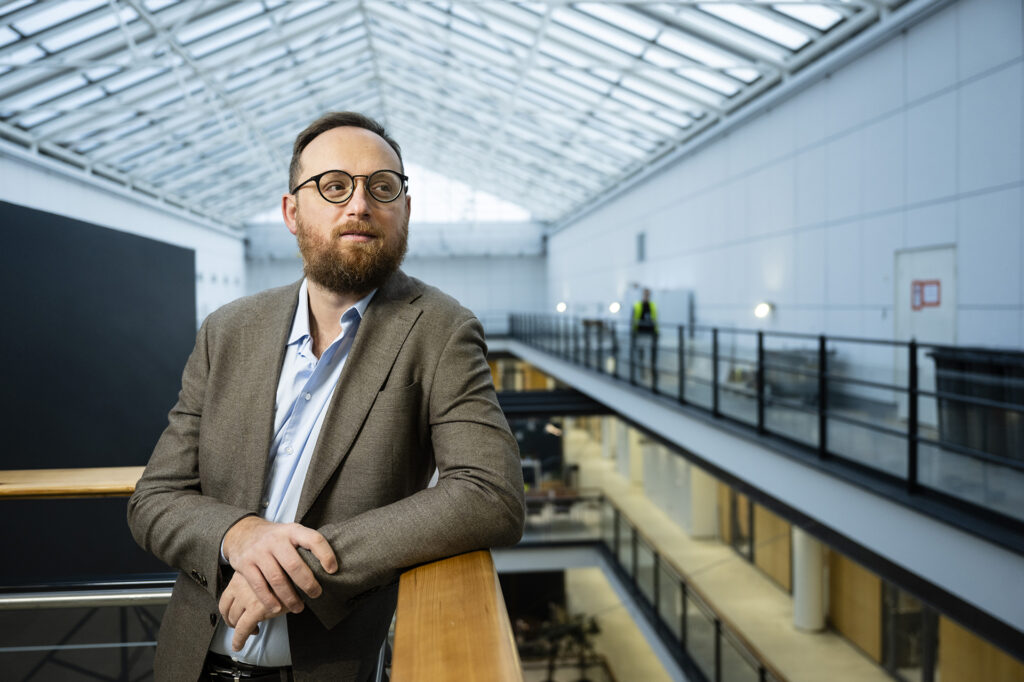
Marco Savarese is Italian and grew up near the Amalfi coast. He completed his Master, his Specialization in Medical Genetics and his PhD in Medical Genetics in Naples. He first came to Finland as a visiting PhD student in August 2014 for three months, and then moved here as a postdoc in November 2015.
“I recently marked 10 years as a Finnish resident. Finland, and the Folkhälsan Research Center in particular, has long been a pioneer in the study of rare genetic diseases, so coming here felt like a natural step for someone like me, who was already deeply committed to this field,” he explains.
And deeply committed he is. An ordinary working day begins with reading emails at home already before going to the office, and ends the same way before going to bed in the evening.
“I want to make sure I can focus and that nothing is overlooked. I go to the office every day. I think it’s important for the team to know that my door is always open for discussions about any issue or idea,” says Marco Savarese. “Twice a week, I attend language courses in the late afternoon, either Finnish or Swedish, and I typically get home around 7:30 or 8 p.m. for dinner. In the evening, I relax by watching TV or a movie, but I also make sure to read and reply to all emails before going to bed. I like to end the day with an empty inbox.”
Comfortably adapted, constantly curious
Adapting to the workplace was not a challenge for Marco Savarese. In fact, quite the opposite. Research work is essentially similar all over the world, the dynamics and settings are very comparable.
“No aspects have felt strange or markedly different. Our lab and research institute are leaders in the fields of muscle diseases and rare diseases, respectively. Our working environment is highly international, and I am genuinely happy to see how our diverse cultural and professional backgrounds strengthen our work,” he says.
“However, I cannot deny that everyday life differs between northern and southern Europe. Even after 10 years, navigating these differences remains extremely interesting. Curiosity is still a major part of my life in Finland.”
Research work is essentially similar all over the world, the dynamics and settings are very comparable.
“The daily schedule varies noticeably,” he continues. “In Southern Italy, lunch is typically around 1:30 pm and dinner around 8:30–9 pm, much later than in Northern Europe. Overall, daily life in Southern Europe is more oriented toward eating and socializing outdoors, while in Northern Europe daily routines shift indoors during the cold months, with a strong emphasis on cozy, comfortable home environments.
“Helsinki has a vibrant and rapidly growing international community, which offers many opportunities and a strong sense of connection for expats. At the same time, it can be challenging to move between this international layer and the more local Finnish way of life. Navigating these two worlds is enriching, but it sometimes requires extra effort to feel fully at home in both,” he says.
Mentoring younger colleagues
Marco Savarese’s strongest motivation right now is supporting the professional growth of young colleagues.
“Nothing is more rewarding than seeing new lab members arrive with curiosity and uncertainty, then develop the skills, confidence and independence to lead their own projects,” he reflects. “I take particular pride in watching them reach important scientific achievements, i.e. publishing their first papers, presenting at international conferences and securing competitive fellowships or independent positions.”

While seeing younger colleagues and trainees grow is rewarding, he never loses sight of why the work matters.
“At the same time, each small or large discovery that has helped a patient, directly or indirectly, is deeply gratifying, as it reminds me of the ultimate purpose of our research.”